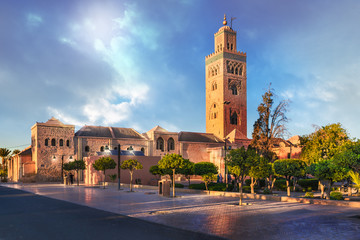
The Koutoubia Mosque in Marrakech is the most emblematic mosque in Morocco. It was erected under the Almoravid dynasty in 1158. It stands at the crossroads of modern and traditional Marrakech: between the Guéliz district and the medina.
Its architecture and its ascetic decoration reflect Almohad art.
A first mosque was built in 1148 by the Almohad sultan Abdelmoumen after he conquered Marrakech. He rebuilt a second version of similar size around 1158. This is the current version, the first having been demolished. Yacoub Al-Mansour finalized the construction of the minaret around 1153. The Koutoubia is considered an important example of Almohad architecture and of Moroccan mosque architecture.
Its minaret towers over the city at a height of 77 meters. It can be seen from up to 25 km away. The large prayer hall has an area of 90 m by 60 m.
The minaret is topped by three gilded copper spheres. It is, moreover, the most decorated element of the Koutoubia. And for good reason: the minaret was built later (around the end of the 12th century) and was therefore not as influenced by the austere architecture of the Almohads.
Although it is only open to Muslims, one can still access the remains of its 17 naves from the gardens that surround it, richly adorned with orange trees where it is pleasant to rest for a few moments before beginning the discovery of the souks, located not far away. Able to accommodate up to 20,000 worshippers and supported by many white columns whose bases can still be seen, this prayer hall of Marrakech, of which only vestiges remain today, once housed one of the largest places of worship in the Muslim world.
The word Koutoubia means in Arabic “bookshop”. It is the mosque of bookshops. It was named thus because it was located in the middle of the booksellers’ souk.
The Koutoubia Mosque is worth a visit at night. It is richly illuminated. Facing it, one feels as if traveling through time and space. This architectural feat is resplendent and unmissable.