Traditional Moroccan music finds its roots throughout its history and its millennial origins.
In this country where it is easy to get lost in its gastronomy, its breathtaking landscapes, its exceptional architecture, Moroccan music accompanies all of Morocco’s life.
Music has been present in Morocco for several centuries; it evolves with the times.
You can find chaâbi and aita from the Atlantic plains (Doukkala-Abda, Chaouia-Ouardigha, Rehamna…), melhoun, Andalusian music of the major cities (Meknès, Fès, Salé, Tétouan, Oujda…) the Gnawa that extends over the regions of Essaouira, El Jadida and Marrakech, or the hassani in the Moroccan Sahara. There is also Amazigh music such as the Aarfa of the Rif, and Reggada of the Béni-Snassen (Oujda, Berkane, Taourirt..) in the northeast of Morocco and throughout the Oriental region in general, the ahidous of the Middle Atlas and the awash of the Souss. Each genre and musical group is made up of regional subgroups, and is furthermore divided between “modern” and “traditional” music.
Moroccans have been using typical musical instruments for generations.
One of them is precisely what is called the “Guembri“, a kind of guitar-drum with gut strings and a soundbox entirely made of wood, used primarily in Gnawa music.
There are also:
the Taɣanimt, a reed flute used to accompany songs;
the Mizwid, largely comparable to a bagpipe and called that because it resembles a “food bag”;
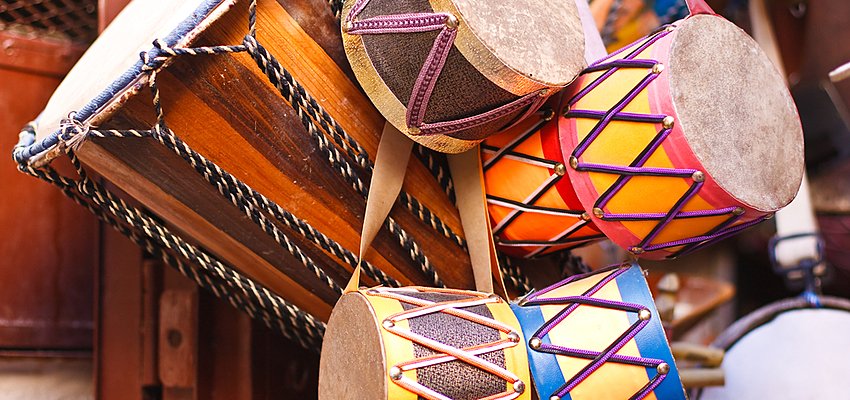
the Tabl, a double-headed cylindrical drum that is positioned vertically against the body to be played standing;
the Qaraqib, large metal castanets that can be held and played directly with a single hand.
These different musics are played for various occasions and events.
For example:
- The “melhoun” is a traditional music that dates from the 12th century. Originally, it was music transmitted orally with poems that sing about daily life in the medinas. This form later came to be accompanied by instruments such as the “oud” (from the family of plucked string instruments, related to the lute) or the “bendir” (a percussion instrument).
- Chaâbi is festive music often played at weddings. Light texts are sung by charismatic singers. The ceramic drum “derbouka” then resounds at these events.
- The “dakka marrakchia”: ritual and folkloric music typical of the city of Marrakech. These sounds often have a religious function since the name of God “Allah” is invoked in order to ward off feared elements such as drought or storms.
- Gnawa music, which arrived from sub-Saharan Africa via caravans, has a very particular rhythm. The “guembri” is the main instrument of these unique sounds.
One of the mythical squares in Morocco is Jemaa El-Fna where you can find groups and dancers who enliven the place.
Source:
https://www.marrakech-private-resort.com/musique-instruments-traditionnels-marocains/
https://ranchdediabat.com/fr/blog/7/musique-marocaine-histoire-et-origines