In this article we will tell you about the making of Moroccan leather and its origins.
Leatherworking is one of the prides and one of the great specialties of Moroccan craftsmanship. The “maroquin”, a word referring to goat and sheep skin, is today a common term to define leatherwork. The making of leather is a tradition rooted in the culture of the largest artisanal cities in Morocco such as Marrakech, Fès, Rabat or even Meknès, to the point that entire quarters of these cities are now dedicated to leatherwork, where Moroccan tanner artisans, in the purest Moroccan tradition, offer tourists an extraordinary spectacle.
It is an art practiced for centuries and that has made Morocco renowned. Tanning spread across the Kingdom under the Almohad dynasty in the 12th century. And since then, nothing has changed. The materials and techniques used are ancestral.
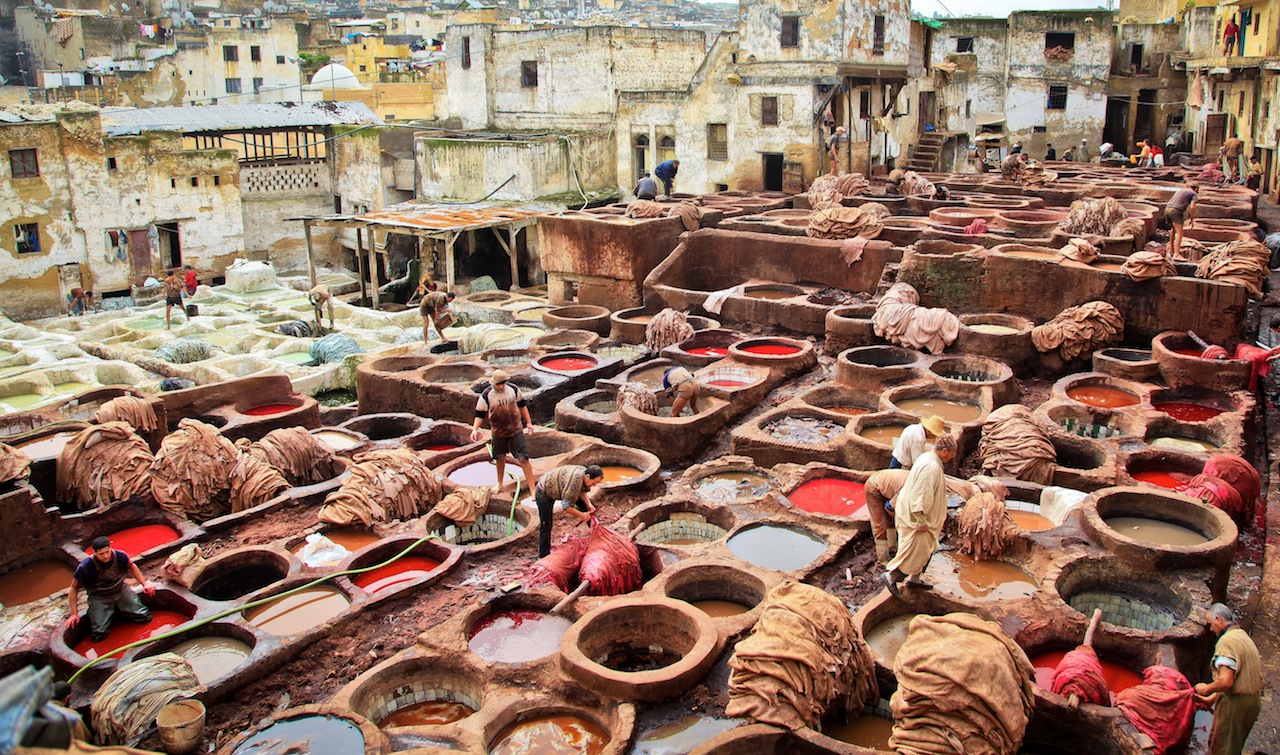
The empire of the senses. The smell tickles the nostrils, the colors excite the pupils and the finished material hugs the skin. At the Chouara tannery in Fès, more than 500 master craftsmen bustle each day in the 1200 vats.
Nearly 900 years old, it is the largest traditional Moroccan tannery. A reference country in leather, it is moreover “Morocco that gave its name to leather goods,” rejoices Oudrhiri El Ralli, managing partner of the Rosaj tannery of Fès. “It is a craft that is very important for the country’s economy.”
In addition to Fès, the tannery in Marrakech and, to a lesser extent, that of Taroudant are also recognized
Techniques several centuries old
At Chouara, the materials worked are the same as in the 12th century. “Sheep, cow, goat and camel skins are tanned,” details Oudrhiri El Ralli. The tanning techniques, likewise, have not changed for a thousand years. “The complete process takes a solid thirty or so days,” assures Abdelhalim Fizazi, member of the artisan chamber of Fès.
For a raw hide to be ready for use, tanners follow three major steps. “The first consists of plunging the hides for several days into vats filled with lime, pigeon droppings and ammonia,” summarizes Matthieu Lavielle.
When it comes time for dyeing, the numerous vats transform into color palettes, all natural. Poppy flower for red, indigo for blue, henna for orange, or even mint for green. Finally, the hides are rinsed, then sun-dried for three days.
The leather is now ready to be delivered to the artisans who will transform it into “garments, bags, babouches or even wallets,” lists Abdelhalim Fizazi.
A preservation plan
In Fès, you must take Méchatine street to find the tanners’ souk, south of the medina. “Because of the strong odors that arise from them, the tanneries are often located away from the city center,” explains Matthieu Lavielle.
“The work of tanners is hard and very harmful to health because of the chemical vapors they breathe all day long.” Industrial tanneries have in recent years supplanted the traditional ones, which are found less and less.
To preserve this age-old know-how, the Medina of Fès, listed as a World Heritage site by UNESCO, should soon be renewed. Last year, the Agency for Development and Rehabilitation released 30 million euros to renovate the 280 hectares of the old city.
Source:
http://www.medinmaroc.com/3-cuir
Photo: https://www.dandy-magazine.com/hermes-rachete-les-tanneries-du-puy/