Moroccan and Berber jewelry
As in all civilizations, the jewelry primarily serves to enhance. It can also indicate belonging to a group.
All civilizations make jewelry and often give them a meaning. In Morocco, there is also a culture of jewelry, notably among the Berbers.
In 2021, Moroccan archaeologists discovered jewelry dating back nearly 150,000 years. These are perforated shells forming necklaces and bracelets. These pieces found in Morocco would be the oldest in the world.
Moroccan jewelry is a very popular artistic creation. Moroccan and costume jewelry are made according to the art of Moroccan artists. They are made with finesse and some are crafted with therapeutic materials. Westerners appreciate these pieces which are very accessible and original. Many motifs have very ancient meanings.
The quintessential motif is the A which represents a man with raised arms who has become the symbol of the Berber nation. Another very widespread motif is a triangle which is the symbol of the tent and the family. There is also the V-shaped motif which evokes the wheat ear.
The variety and quality of Moroccan and Berber jewelry play an important role in Morocco’s history and culture. Beyond their beauty, jewelry play an important role in society. Jewelry does not only show the social class of those who wear them; they have a symbolic and protective value.
Moroccans have always been skilled and inventive in creating and offering splendid jewelry. They work with all kinds of materials, but they work much more often with silver than with gold. This material is very present in Berber jewelry. It is much more accessible and malleable, allowing greater possibilities for fantasy designs. Many ethnic pieces are in silver with semi-precious stones. Other materials are also used such as copper for their therapeutic virtues.
The Berbers are enthusiastic about jewelry in Morocco.
We can give a reminder of who the Berbers are.
It is estimated that about 60% of today’s Moroccan population can be considered of Berber origin.
The term “Berbers” was used by the Romans of Antiquity to designate the inhabitants of Numidia, the Amazigh people. It is curious to note how this culture, which dates back to 5000 BC, lost its name in an instant, forever overlaid by the Greco-Roman label “Berber” (from “barbarian”), which moreover had a pejorative meaning. It may therefore not be a coincidence that, in the history of Morocco, Berber culture and roots were always denied and hidden by the ruling classes. It is only in recent decades that the Moroccan people have come back to proudly rediscover their Berber-Amazigh tradition, language and history.
Today the Berbers are widely represented and honored.
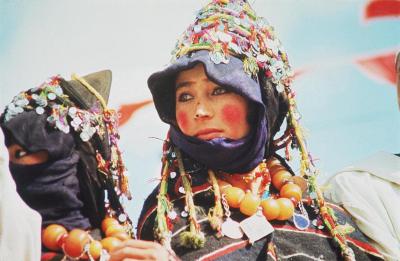
The Berbers have always placed great importance on jewelry. Indeed, in history, representations of Berber women are always shown with jewelry typical of the Berber people. For this millenary people, jewelry has always had great significance; in addition to being decorative, they represent belonging to an ethnicity, a group, a social category. But they also have a protective and thaumaturgic value, powers that also vary according to the materials used.
Berber and Tuareg jewelry is very popular. Everyone knows the iconic piece called “the Hand of Fatima.” In Morocco this piece is actually called Hamsa or Khamsa, which in Arabic means “5”, like the number of crossed fingers represented in the symbol. The origin of this symbol is uncertain, but we know for certain that it was also used and venerated in ancient Carthage in the ninth century BC.
These icons are known to all and remain essential for jewelry fans. The artisans continue to create wonders; they make jewelry using different materials even though silver remains the most used. They use various stones of different colors and vary the shapes. All bracelets, rings and necklaces are true artistic creations and typical of Morocco’s craft culture.