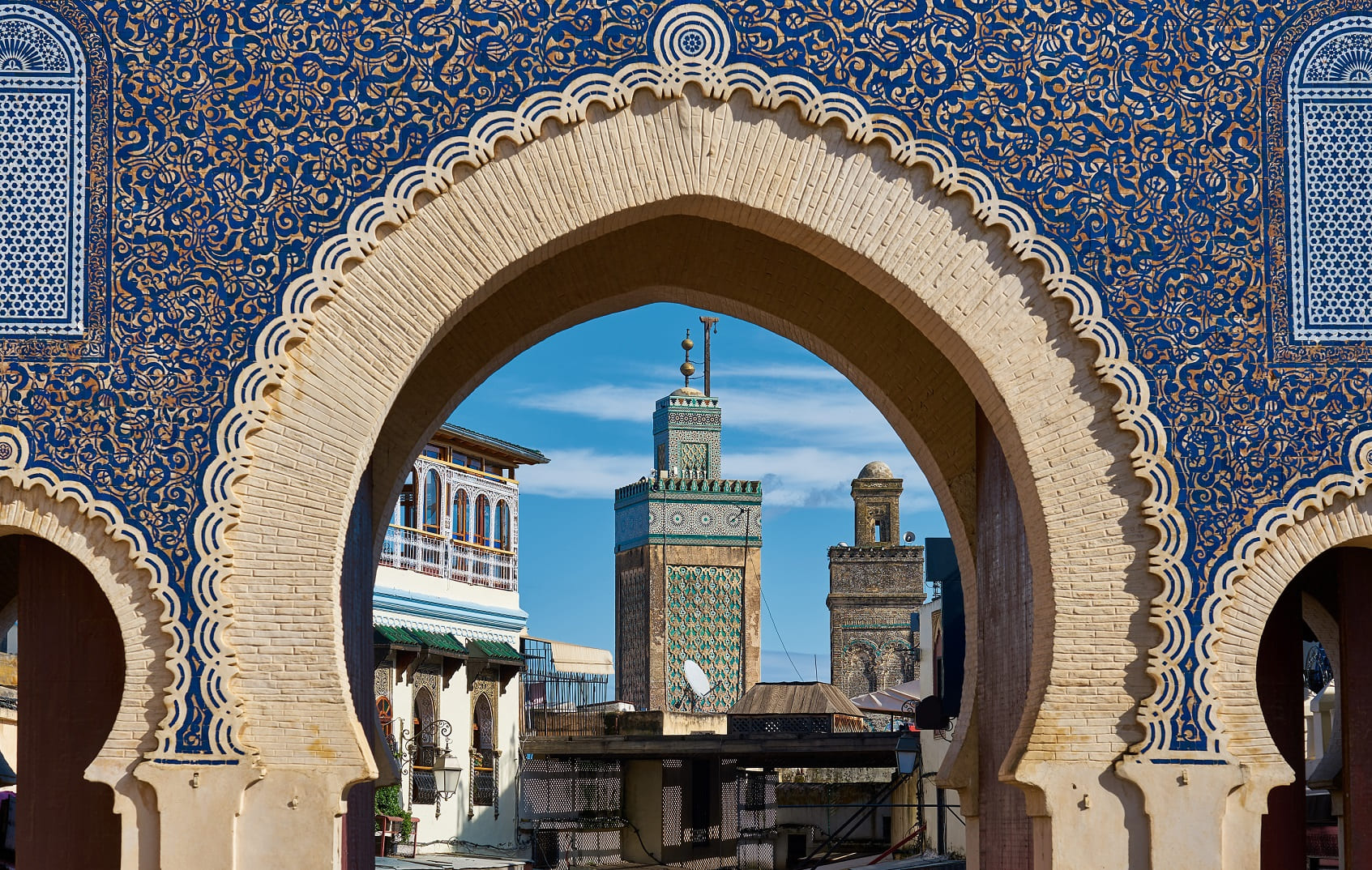
Fes is a city of Morocco, located between the massif of the Rif and the Middle Atlas. As one of Morocco’s imperial cities, it has at various times been the country’s capital and is nowadays considered its spiritual capital. Its foundation dates back to the end of the 8th century, under the reign of Moulay Idriss Ist. Its past prestige made it one of the major centers of Islamic civilization connected to Baghdad, Damascus, Cordoba, Cairo, Kairouan, Granada, Palermo, Isfahan and Samarkand, with which it had established exchanges both economic and social and cultural.
Various titles have been attributed to the city of Fes, including the Athens of Africa, the queen of the Maghreb and the Bagdad of the Maghreb.
It is spread across two sectors: the old city (medina), listed as a UNESCO World Heritage site, the royal enclosure and the new quarters, established by the French, which today extend into the surrounding plain. Administratively, the city is made up of the municipality of Fes (divided into six districts) and the municipality of Méchouar Fès Jdid (where the royal palace is located).
It was founded in 789 AD by Idriss I. His son, Sultan Idriss II, decided in 809 to establish there the seat of the dynasty. By 818, the sultan welcomed into his city 8,000 families of Andalusian Muslims. Seven years later, this new population was reinforced by the arrival of Jews and Kairouanians (today’s Tunisia). Rich in these multiple religious, cultural and architectural heritages, Fes quickly became the religious and cultural center of Morocco. From then on, despite dynastic wars and periods when it was not the country’s official capital, the imperial city never ceased to grow and beautify. Today, Fes is undoubtedly the most authentic city in North Africa. The intellectual influence of its Quranic university, its famous Karaouiyne mosque, its treasures of Arab-Andalusian art, its medieval medina of Fès el-Bali and its highly talented artisans make it the guardian of the traditions of Islam.
Fes is at the crossroads of several trade routes joining the south with the Sijilmassa and the Mali and to the north via the ports of Tangier and Ceuta, to the east via Marrakech and to the west via Tlemcen, Tunis and farther on Cairo and Mecca or Damascus.
Fes, an age-old city, knows how to preserve its deep personality while opening up to modernism. Fes relinquishes the status of capital to Rabat, but remains the spiritual capital of this Morocco deep in history.