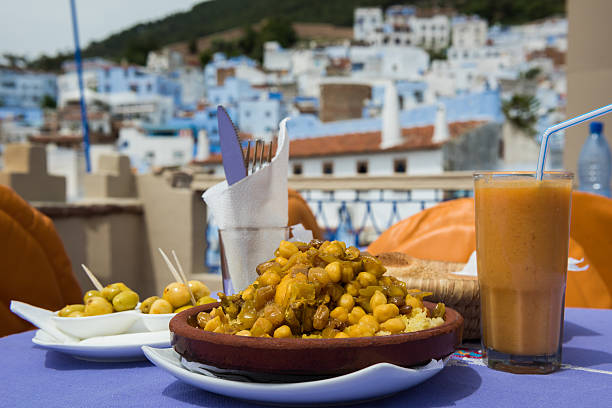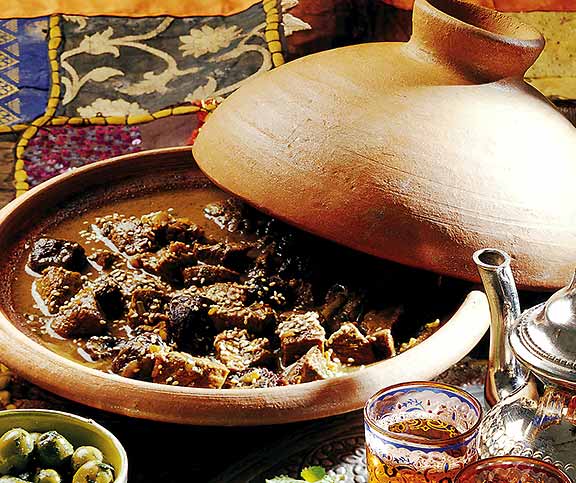
The tagine is a cooking utensil but also a traditional Moroccan dish.
What does tajine mean?
The Berber word berbère « tajine », derived, like the Provençal « tian », from the Greek « têganon » which means « earthenware dish », refers as much to the Moroccan recipe as to the cooking utensil, a kind of shallow clay plate topped by a conical lid.
The tajine is magical, you only need to place all the ingredients in this earthenware dish to bring out a culinary feat.
This dish does not require water or fats; the cooking is done by steam.
The tajine is said to have been invented by the Berbers long before our era. For this nomadic people, what could be better than a utensil that is both a cooking dish and a serving dish? In a country where fresh water is scarce and precious, this earthen pot allows one to cook by steaming everything the land offers: seasonal vegetables and dried fruits, with fish on the coasts – as in Safi, Essaouira or Agadir – or meats in the inland areas and the Atlas Mountains.
This stew is suitable for hole-in-the-wall eateries as well as upscale restaurants. It is the emblem of Moroccan hospitality. Whatever the recipe, the ritual does not change: the dish is taken off the heat and placed on a low table, and the guests pick from it with their hands, using bread. That is perhaps the tajine’s greatest spell: its conviviality.
The tagine can come in different forms. Here we mainly spoke of the tajine as a dish and cooking instrument. There are also tajines that serve as decoration; these are the ones that have ornaments painted on them.
The tajine is part of Moroccan culture and its art.