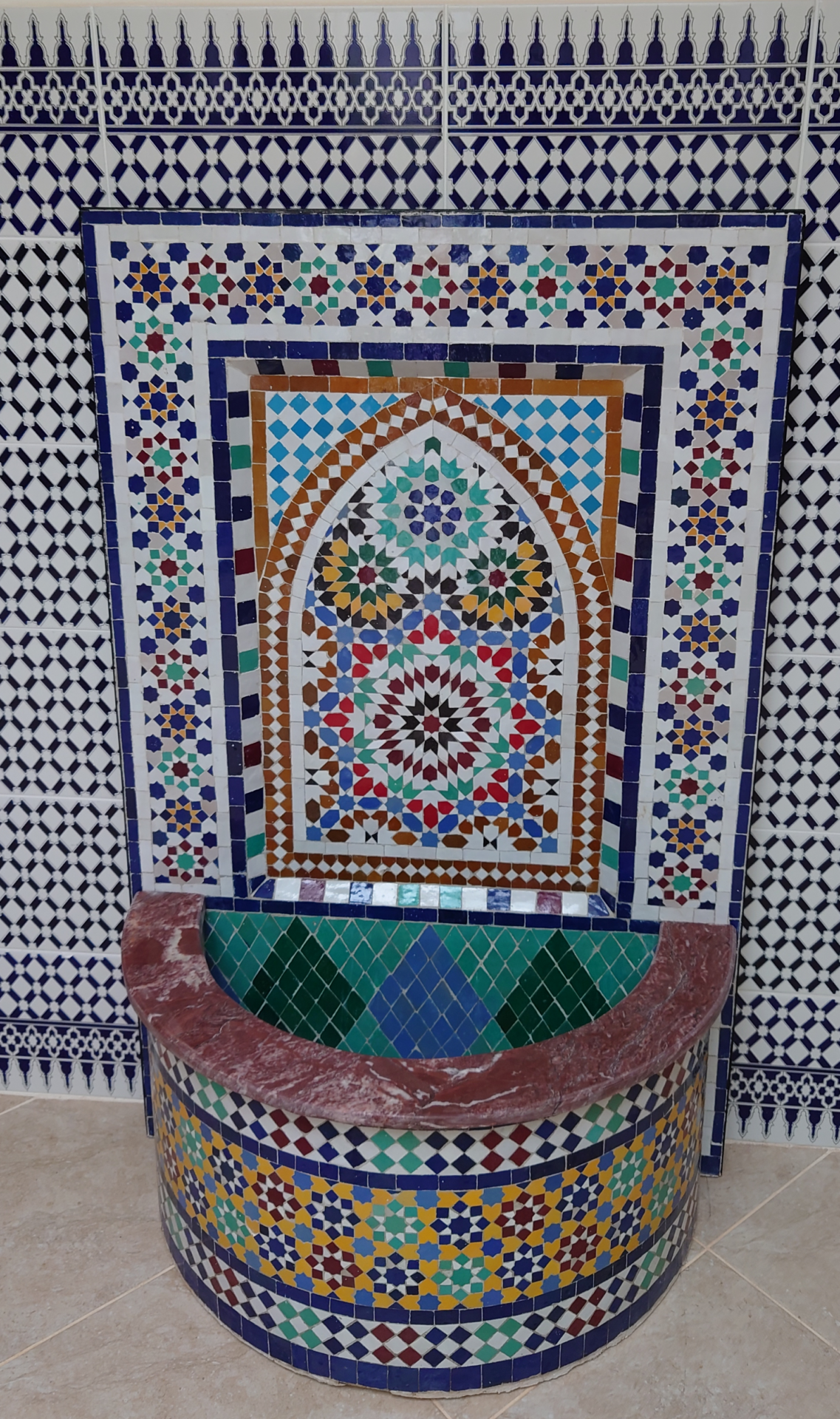
Zellige (small polished stone) is a mosaic whose elements are tesserae. These glazed terracotta pieces are cut one by one and assembled on a bed of mortar to form a geometric composition.
Zellige appears in Morocco in the 10th century with shades of white and brown. Later, in the 14th century under the Marinid dynasty, the colors blue, green and yellow were incorporated into this mosaic.
The Marinids made extensive use of it in Fes and Meknes; these cities are the center of this art. The color red only appears from the 17th century.
You can admire zellige creations throughout Morocco, notably in Fes, Meknes and Marrakech. Zellige is also very present in Andalusia on monuments built during Muslim rule. For example, zellige decorations can be found in the Alhambra palace (14th century), which showcases Islamic art of that period.
Zellige is used to cover walls, floors and fountains. It is found as a decorative element in traditional Moroccan houses as well as modern ones. This ancestral art has managed to endure through the ages and retain all its charm. Today you can find decorative zellige with a mosaic composed of several natural colors.
The tiles used for zellige are 2 cm thick. Sometimes squares of about 10 x 10 cm with their corners cut are used to be combined with a colored cabochon.
To cover floors the Bejmat is used; it is a rectangular paving stone of 14 x 4.5 cm that is laid in a herringbone pattern.
In Morocco, traditional garden fountains adorned with zellige can be found. These fountains can reach up to 2 meters in height. Fountains made with zellige are representative of the know-how of Moroccan artisans. They illustrate the mastery of this exceptional art. Artisans are able to reproduce complex patterns by cutting zellige tiles one by one and skillfully assembling them. The perfectly achieved symmetry testifies to the abilities of Moroccan artisans to work at all scales.
Such sumptuous results can only be obtained by seasoned craftsmen who are perfectly trained over several years. It is more than an art; it is a culture and an ancestral know-how. Mastery of zellige decoration is a majestic art.
All this artistry can be admired in many creations, notably fountains. They are displayed in gardens or houses like a royal throne.
Today zellige is a source of new ideas for designing homes and gardens.