Oujda is the capital of eastern Morocco, the capital of the Masjids (mosques), or also the millennial city; it is one of the oldest cities of Morocco.
Located in the center of the Plain of Angad, in the northeast of the country, bordered to the north by the mountains of Béni-Snassen and to the east by Algeria. Oujda was founded by the Zenata Berber chief Ziri Ibn Attia around 994.
It is the capital of the prefecture of Oujda-Angad, in the Oriental region; its proximity to Algeria makes it a crossing point between Morocco and Algeria. It is a major city of Morocco.
Because of its advantageous position at a rail and road junction, controlling traffic towards the High Plateaus and the South as well as transit to Algeria (this latter railway line has been closed since 1994), it has experienced rapid development.
It serves as the regional capital for the whole eastern Morocco (administrations, commerce and services with a wide reach). It is situated in the heart of a fertile plain where wheat, olives and grapes are cultivated; goats and sheep are raised there. Industrial activities, relatively modest, are concentrated notably in the Al Boustane area.
The city has an international airport and several faculties and institutions of higher education.
Throughout its history, the vicissitudes experienced by Oujda were those of a border town passing from one power to another according to the fortunes of war and also a relay town on the Sijilmassa-Orient. After it was occupied by France in 1907, Oujda, faithful to the Alaouite Throne, contributed effectively to the struggle for Morocco’s independence.
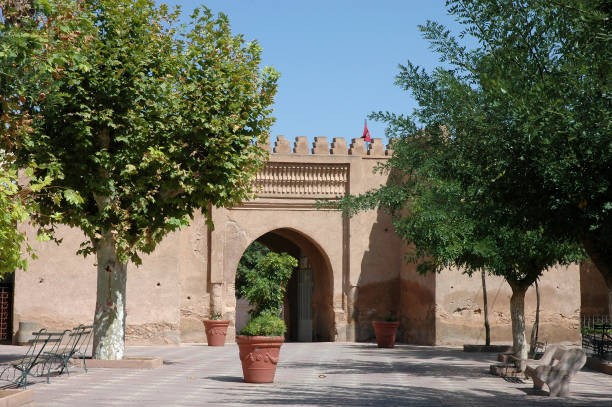
Among the city’s monuments are Bab El Gharbi, an archaeological gate opening onto Oujda’s square, and Bab Sidi Abdelwahab, opening onto Abdelwahab Square.
Oujda is an ancient and important city of Morocco. Today you can lose yourself in the souks of Oujda surrounded by the fortifications of the Kasbahs.