The history of Marrakech begins with its founding in 1062 by Youssef ben Tachfine, leader of the Almoravid dynasty. They established schools of Quranic theology, thereby conquering all of Morocco. Ben Tachfine is considered to be the father of Morocco.
The Almoravid caliph Abd al-Mumin had two mosques built, one of which is the celebrated Koutoubia Mosque, inspired by Al-Andalus art which recalls the Giralda Mosque.
Following the defeat of the Almoravids, the Almohad dynasty settled in — they were called the « unifiers » of Berber Islam. The era of the Almohads corresponds to a period of flourishing for Marrakech. Many constructions recall the splendor of that time, such as the majestic entrance of the Kasbah, a fortress housing a mosque within it.
In 1230, al-Maymun of the Marinid dynasty, aided by Ferdinand II, conquered Marrakech. Shortly after, his brother Abu Yusuf drove out the Almohads and the Marinids who had ruled for two centuries. During the Marinid period, the city somewhat fell into obscurity ; at present there remains no trace of its past.
The Marinid dynasty was followed by the Wattasid dynasty, and then power passed into the hands of the Sharifian dynasty.
The Sharifs are descendants of the Prophet Muhammad through his daughter Fatima, who married Ali. The name of Muhammad’s son-in-law, Ali, gave rise to the Alaouite dynasty ; this is the dynasty to which the current king of Morocco belongs. That is why the kingdom is called the « Alaouite Kingdom », formerly named the « Sharifian Empire ».
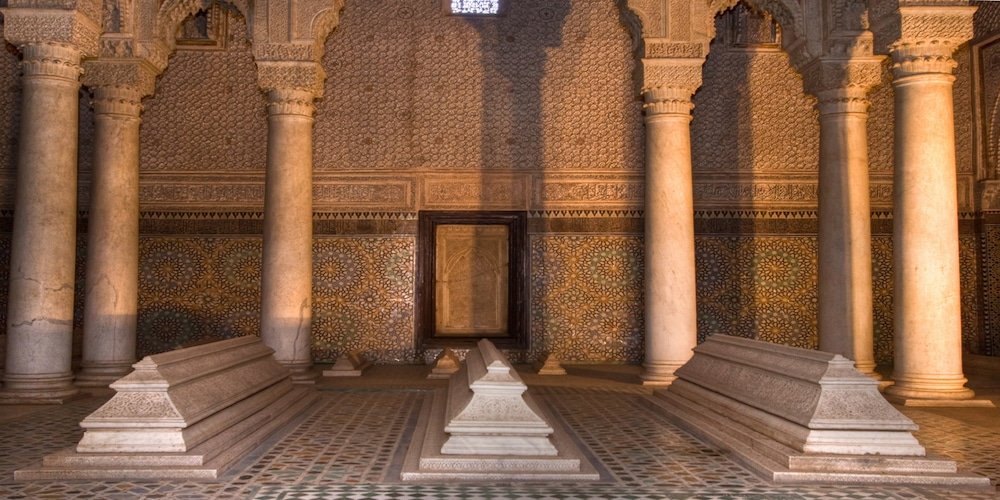
The Sharifs took power in the 16th century. Of this period are remembered the Bab Doukkala and Mouassine mosques and Saïd Al-Jazouli ; the Ben Youssef madrasa of 1570 and the Saadian tomb of Al-Mansour and his family.
Marrakech hosted the majority of the important historical events that shaped Morocco’s identity. Portuguese, Spanish and French first drove out the corsairs to control and benefit from the natural resources and the privileged position at the gates of Africa.
Marrakech experienced a turbulent history up until Morocco’s independence in 1956, with rare periods of peace, often due to the ambitions of European countries.
In 1911, Morocco’s capital became Rabat, relegating Marrakech to the background. Today, it is a city that lives mainly off tourism, agricultural products exported to Europe as well as canned fruits and vegetables. It is the region’s center of commerce and the transport hub for minerals extracted from the Atlas.
Today Marrakech is a major tourist city in Morocco. Each year it receives millions of people who come to visit to enjoy its beautiful avenues, its souks, its palaces and its large Jamaa El Fna square. The beautiful red city continues to amaze the world.
Source: https://www.marrakech.fr/histoire
https://generationvoyage.fr/visiter-tombeaux-saadiens-marrakech/