In Morocco, pastry is part of the culture and of Moroccan tradition. It is a source of refinement and an exceptional culinary experience. Everything begins with pastry in Morocco.
In its flavors, its ingredients and its manufacturing secrets, one finds all the roots that have nourished Morocco since time immemorial, the influences that have come to color its culture, the women, the men and the peoples who have gathered over the centuries.
Moroccan pastry has Mediterranean origins. As far back as one goes, the roots are Berber, for at least twenty centuries, with the rghaif, pancakes made from puff pastry, and the beghrir, pancakes made from fritter batter.
During the time of the Umayyads and the Abbasids, people arrived from Arabia and Iraq with new recipes based on honey, almonds, oil, sesame, pistachios and peanuts…. In the 16th century, the Turkish influence was felt. With the decline of the Arab presence in Andalusia, many Andalusians, of Muslim or Jewish faith, settled in the city of Fes, bringing their culinary traditions with them. Thus over time, the number of specialties has remarkably increased.
All pastries are kneaded and shaped by hand.
The baghrir or khringo, also called in French the thousand-hole pancake, is a Maghrebi pancake widespread throughout the Maghreb prepared from semolina, flour, yeast and salt, served hot, soaked with olive oil or honey.
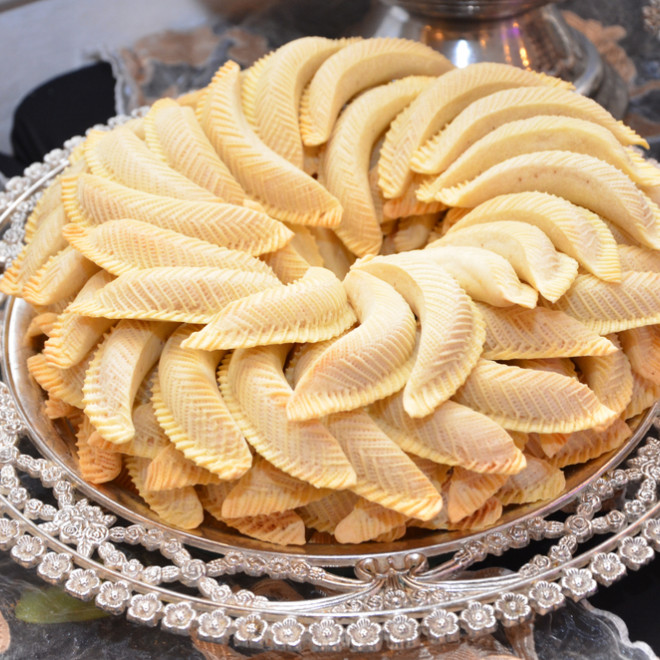
The ghribia is a pastry specialty prepared throughout Morocco.
It is a shortbread made by hand, made from flour, sugar, oil and/or butter, flavored with lemon or orange zest, cinnamon, etc. This pastry is generally served with coffee or mint tea at celebrations, notably on Eid. It is often associated with the mantecados of Andalusia.
The corne de gazelle كعب الغزال (gazelle’s horn) is a Moroccan pastry shaped like small croissants whose soft center contains almond paste, cinnamon and orange blossom water.
The transcription “corne de gazelle” seems to be a French adaptation of the Arabic term, the ghazal being the gazelle in French.
Feqqas is a Moroccan dry cake. It is made of eggs, sugar, flour and yeast to which almonds and/or raisins can be added. It is served with mint tea
The sellou is a dessert consumed in Morocco. Very nutritious, it is prepared from roasted flour, mixed with toasted almonds, honey, sesame, melted butter, and other spices such as anise and fennel.
The briwate or briouate is a puff pastry turnover, generally triangular or cylindrical in shape, typical of Morocco. It can be sweet or savory.
The almond triangle is the sweet variety; it is prepared from roasted almonds, sugar, orange blossom water and cinnamon, all wrapped in a sheet of brik (warqa in Morocco), shaped into a triangle and coated in honey.
In Morocco, the sfenj are prepared mainly from flour, which gives them a lightness and a different taste.
All these pastries are staples in Morocco and have existed for centuries. Pastry in Morocco is part of its craft, its history and its identity.
The sweet delights that line Moroccan tables form an extraordinary mosaic of the senses.